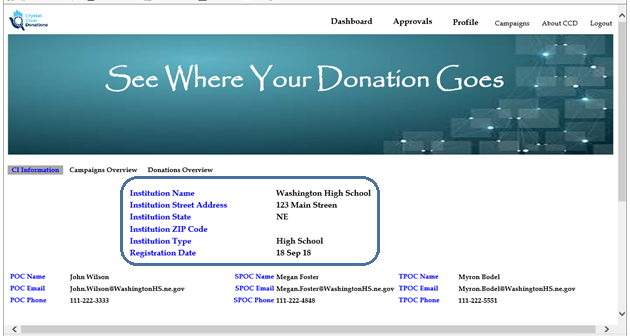
| A main aspect of CCD is that only registered tax exempt institutions can post campaigns – individuals cannot. In the Campaigning Institution (CI) Information portion of the Dashboard, registered members of the CI can easily view information of the CI, including the Institution’s name, address, type and the registration date. |
|
Clearly, the Institution’s name and address are self-explanatory.
|
|
|
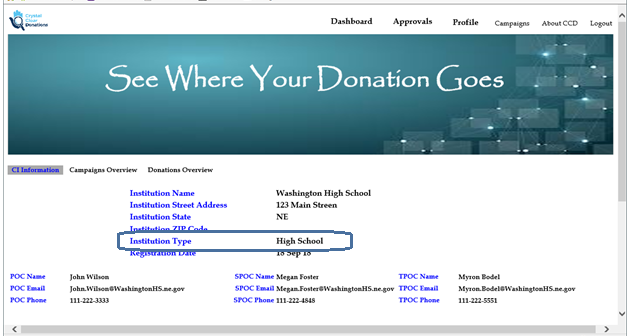
The institution type may be a type of school, state or local law enforcement agency, fire department, hospital or any other type of tax exempt institution.
|
|
|
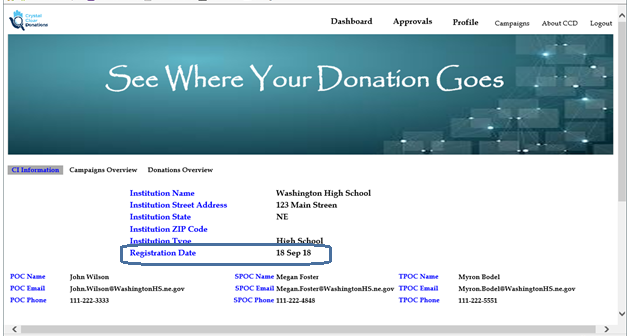
The registration date is the date that the CI registered to post campaigns on the CCD website.
|
|
|
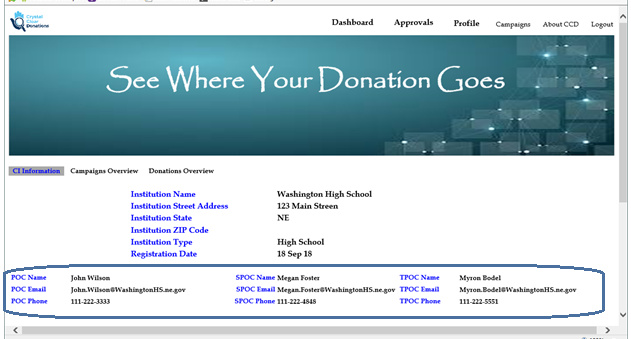
The registered members of the CI include the primary Point Of Contact (POC); the Secondary Point Of Contact (SPOC); and the Tertiary Point Of Contact (TPOC).
|
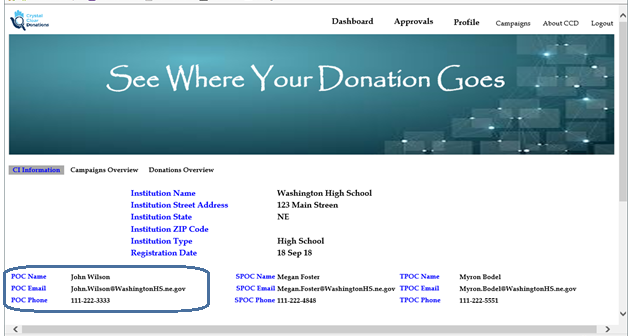
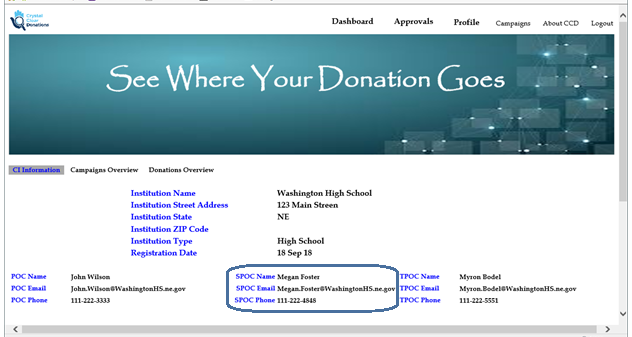
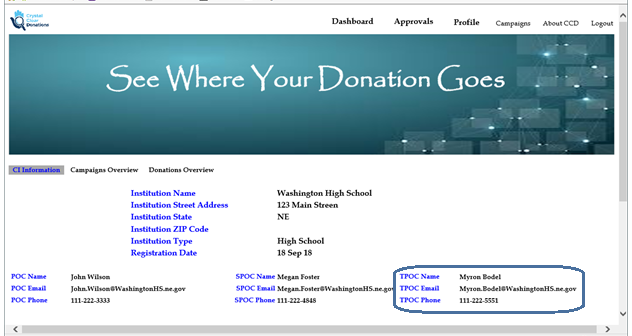
| Here in the CI Information page of the Dashboard, the name, email and phone number of the POC, SPOC and TPOC can be seen. |
|
|
But what are the POC, SPOC and TPOC?
|
The POC is only the person, who may submit requests to post campaigns.
In the example of a high school, the POC may be a person at the front office, let’s say a secretary in the front office. In such a case, every teacher, administrator or coach, who wants to start a campaign to raise a specific amount of money for a delineated good or service, must submit the request to campaign to this secretary.
In the example of a Sheriff’s Office, the POC may be Sheriff’s executive assistant, for example. In such a case, every deputy, office worker or volunteer, who wants to start a campaign to raise a specific amount of money for a delineated good or service, must submit the request to campaign to the Sheriff’s executive assistant.
The POC will then submit the request for the campaign to CCD. By having a single point of entry into CCD, the CI is able to easily oversee what members within the CI are attempting to raise money through CCD.
|
|
The SPOC is one of two people, the TPOC being the other, who will approve any requests to post campaigns that have been submitted by the POC. At CCD, we suggest the SPOC be a high ranking official, if not the head of the CI. We further suggest that the SPOC be responsible for approving the subject matter of a campaign request.
In the example of a high school, the SPOC may be the principal. In such a case, the principal will review each campaign as submitted by the POC to determine whether the subject matter is appropriate. For example, should a football coach be raising money for football equipment? Probably. Should a math teacher be raising money for a salt water fish tank? Probably not.
In the example of a Sheriff’s Office, the SPOC may be the Sheriff. In such a case, the Sheriff will review each campaign as submitted by the POC to determine whether the subject matter is appropriate. For example, should a deputy be raising money for a new K-9 unit? Probably. Should a volunteer be raising money for an office Halloween party? Probably not.
By having the SPOC only reviewing campaign requests for subject matter eligibility, the amount of required work and consideration is drastically reduced from an already overworked head of the CI. On the other hand, the head of the CI is able to keep a finger on the pulse of the institution and provide oversight as to who is raising money and for what purpose.
|
|
The TPOC is one of the two people, the SPOC being the other as discussed above, who will approve any requests to post campaigns that have been submitted by the POC. At CCD, we suggest the TPOC be another high ranking official. We further suggest that the TPOC be responsible for approving the amount of a campaign request.
In the example of a high school, the SPOC may be a vice principal. In such a case, the vice principal will review each campaign as submitted by the POC to determine whether the amount of money being sought is appropriate. For example, should a football coach be raising $32,468 for football equipment? Maybe not – the TPOC can make the call. Should a math teacher be raising $242 for a salt water fish tank? Maybe so – the TPOC makes the call.
In the example of a Sheriff’s Office, the TPOC may be an undersheriff. In such a case, the undersheriff will review each campaign as submitted by the POC to determine whether the amount of money being sought is appropriate. For example, should a deputy be raising $6527 for a new K-9 unit? Maybe not – the TPOC can make the call. Should a volunteer be raising $271 for an office Halloween party? Maybe so – the TPOC makes the call.
By having the TPOC only reviewing campaign requests for cash value eligibility, the amount of required work and consideration is drastically reduced from an already overworked CI administrator. On the other hand, CI administrator is able to keep a finger on the pulse of the institution and provide oversight as to who is raising money and for what purpose.
|
|
In short, the POC is the gatekeeper, the SPOC oversees the subject matter and the TPOC oversees the amounts requested. This triple point of contact scheme provides for important features.
First, no one person is overwhelmed by managing fundraising for an entire institution.
Second, by virtue of the POC, there is only a single person that can submit requests for fundraising campaigns. In this way, overall institutional oversight of fundraising is extremely simplified.
Third, the upper management, by way of the SPOC and TPOC, are easily able to have precise oversight of all fundraising for the entire institution.
Fourth, the likelihood of waste, fraud and abuse is drastically reduced. In particular, because the POC, SPOC and TPOC have distinct approval roles, each of the POC, SPOC and TPOC must conspire to do something improper in order for something improper to occur.
|